
At a glance
| Topic | In brief |
|---|---|
| Journey | One or two changes, around 16 to 24 hours in total |
| Destination airport | Manaus, Eduardo Gomes (MAO) |
| On to the village | Depending on conditions, roughly 35 to 45 minutes' travelling time by boat from Marina do Davi |
| Visa | Not required for German nationals (tourism, up to 90 days) |
| Passport | Valid for at least another six months |
| Time zone | Six hours behind Germany in summer, five in winter |
| Language | Portuguese. English is of little help, Spanish somewhat more. |
| Currency | Brazilian real (R$). Cash only in the village. |
| Climate | 25 to 33 degrees all year round, high humidity |
| When to travel | Possible all year round. High water roughly March to August, low water roughly September to November |
| Most important vaccination | Yellow fever, at least ten days before departure |
| Mosquito risk | Considerably lower on the Rio Negro than in the rest of the Amazon region |
How to get there
Flights
There is no direct flight from Germany to Manaus. The international routes serving Manaus change frequently — check the current connections when you book. These are the usual routes:
- Via São Paulo (GRU) or Brasília — the most reliable option, with many connections into the Amazon region
- Via Panama City or Bogotá — often the shortest overall journey time and frequently the cheapest fare
- Via Lisbon or Madrid — depending on the season, with a connection within Brazil
- Allow for a total journey time of 16 to 24 hours
- Allow at least three hours when changing in Brazil — domestic flights become increasingly delayed as the day goes on
- Have your luggage checked through if possible; if not, you will need time for immigration and re-checking it
- You clear immigration at the first Brazilian airport, not in Manaus
Arriving in Manaus
- Eduardo Gomes Airport is about 15 kilometres north of the centre
- The best way into town is by Uber or 99 — cheaper and more transparent than a taxi
- There are cash machines in the arrivals area, and SIM cards too — but do not rely on them; arrive with working internet instead (Chapter 3)
- Many intercontinental flights arrive at night. Book your hotel for that night as well — not just from the following day.
On to the village
The journey starts at Marina do Davi on Av. Coronel Teixeira in the Ponta Negra district and, depending on the weather, water level and boat, takes roughly 35 to 45 minutes' travelling time across the Rio Negro. We do not arrange the transfer automatically, but on request and for an additional charge — please let us know your arrival day, time and hotel in good time.
Documents, insurance, money
Documents
- Passport, valid for at least six months beyond the end of your trip
- No visa required for German nationals on tourist stays of up to 90 days
- International vaccination certificate with yellow fever entry — not required to enter Brazil, but needed for onward travel to some neighbouring countries
- Copies, digital and on paper — passport, insurance, bookings, vaccination certificate
Insurance
Travel health insurance including repatriation is no luxury on this trip. The nearest major hospital is in Manaus; anything beyond that means a domestic flight.
It is important to have realistic expectations here: as a rule, insurers reimburse treatment, repatriation and official medical transport for which there is a Nota Fiscal — the official Brazilian invoice. The journey from the village to the city, by contrast, is by privately arranged boat and car; there is no such invoice for this, and whether a policy will cover it in a given case cannot be said in advance. Ask your insurer in writing, and plan an additional reserve of your own. Chapter 13 explains the order of magnitude involved.
Money
- The local currency is the real (R$). In Manaus almost everything is paid by card
- In the village you will need cash — for handicrafts and tips
- Withdraw money from a cash machine at the airport or in town; exchanging money in Germany is not worthwhile
- Bring small notes. A 100 R$ note is hard to change in the village
- A credit card for the hotel and restaurants, plus a second card kept separately
- PIX is Brazil's instant bank transfer and is used everywhere — but it only works with a Brazilian bank account
Mobile phone and internet
- Check beforehand: does your device support eSIM, and is it SIM-free (unlocked)? Both are usually the case with newer devices.
- Set everything up and test it before you fly. Buying a Brazilian prepaid card locally often requires a CPF — the Brazilian tax number, which tourists do not have. This regularly causes frustration at the airport.
- There are plenty of providers — international travel eSIMs as well as the Brazilian networks Vivo, Claro and TIM. For one to two weeks, a few gigabytes are enough.
- Keep your German SIM active, but switch off data roaming. That way you remain reachable on WhatsApp under your usual number, without unexpected roaming charges.
- Network coverage: good in Manaus, unreliable to non-existent on the river and in the forest. The village has Wi-Fi via satellite.
- Download beforehand: offline maps of Manaus, the Portuguese language pack, your booking documents.
Health
Vaccinations
| Vaccination | Note |
|---|---|
| Yellow fever | Strongly recommended for the Amazon region. At least ten days before departure. According to the WHO, one dose gives lifelong protection. |
| Hepatitis A | Recommended. Transmitted through water and food. |
| Tetanus, diphtheria, polio | Check your standard protection and have boosters |
| Typhoid | Advisable depending on travel style and length of stay |
| Hepatitis B | For longer stays or possible medical contact |
| Rabies | Worth considering for longer stays and close contact with nature — in the Amazon region also because of bats |
Malaria
The Brazilian Amazon is the country's malaria region. On the Rio Negro, however, the risk is considerably lower than in the white-water areas — Chapter 5 explains why.
- For Manaus itself, preventive medication is generally not recommended.
- For rural parts of the Amazon, depending on length of stay and travel style, either prophylaxis or emergency standby medication may be considered.
- What makes sense for you is decided by your travel medicine consultation — not by this guide and not by the internet.
Important, just in case: any fever after a trip to the Amazon should be checked by a doctor, even weeks or months later. Be sure to mention your trip.
Other mosquito-borne diseases
Dengue, Zika and chikungunya occur in Brazil, including in Manaus. The mosquitoes that carry them bite during the day and breed in artificial water containers in settlements — so the river chemistry does not help here. Consistent insect protection therefore makes sense during the day as well.
Water and food
- There is filtered drinking water in the village — you do not need to buy water
- In Manaus, drink bottled water and avoid ice cubes in simple eateries
- Anything cooked, fried or peeled is fine
- Fish is generally prepared fresh and cooked through locally; please let us know about any individual intolerances or allergies in advance
Travel first-aid kit
- Personal medication in sufficient quantity, in your hand luggage
- Anti-diarrhoea medication and electrolyte powder
- Painkillers and fever reducers
- Plasters for wounds and blisters, disinfectant, wound ointment
- Antihistamine for insect bites and allergic reactions
- High-factor sun cream, after-sun
- Insect repellent with DEET or icaridin
- If you take medication regularly: note down the active ingredient names, not just the brand names
Why the Rio Negro is different
When people hear “Amazon", they think of swarms of mosquitoes and fever. On the Rio Negro this picture is far less accurate than elsewhere — and there is a solid reason for that.
Black water
The Rio Negro deserves its name: its water is deep brown to black, as clear as strong tea. The colour comes from humic acids and tannins from decomposed plant material in the surrounding sandy soils. These substances make the water highly acidic — the pH is often between 4 and 5, somewhere between vinegar and orange juice.
At the same time, the water is extremely poor in nutrients. Together, these make an exceptionally poor habitat for mosquito larvae, which need nutrient-rich, standing and fairly neutral water.
One of the warmest large rivers in the world
The water of the Rio Negro is around 29 to 31 degrees all year round. That is warmer than most bathing lakes in a European midsummer and makes swimming here something special: you can stay in the water for hours without getting cold.
What is more, thanks to the low pH and low nutrient density, the bacterial load is lower than in many other tropical waters.
What this means for your trip
A stay on the Rio Negro, roughly 35 to 45 minutes by boat from Manaus, is something different from an expedition deep into the rainforest or a journey up the Solimões. Distances are comparatively short; electricity and satellite internet are available on site at all times.
That does not mean caution is unnecessary. It means the necessary precautions are manageable — vaccinations, insect protection, sensible clothing and common sense.
When to travel
The temperature barely changes throughout the year. What does change a great deal is the water level: the Rio Negro rises and falls by several metres over the course of the year. This transforms the landscape and, with it, the experience.
| Time | What to expect |
|---|---|
| Roughly March to August | High water, usually peaking in June and July. Boat trips through the flooded forest (igapó), by boat right in among the treetops, lush vegetation, hardly any beach. |
| Roughly September to November | Falling and low water, usually at its lowest in October and November. Sandy beaches, good walking in the forest, more animals visible on the banks. In October and November, swimming in the river is usually no longer possible because of mud. |
| Roughly December to February | Rising water, more rain. A transitional period: the beaches get narrower and the first stretches of forest are under water. |
The months are a guide only. The water level shifts by a few weeks from year to year. Feel free to ask us about the current situation before you book.
Rain here usually falls as a short, heavy shower and rarely as persistent rain. As a result, a day is almost never lost — you simply wait it out and carry on.
A note for photographers and birdwatchers: at high water (roughly March to August) you can take a boat right in among the treetops. That is an experience you will not have at low water (roughly September to November).
Manaus
A city of over two million people in the middle of the rainforest, with no road connection to the rest of the country. Manaus became unimaginably rich during the rubber boom of the 19th century — and the city centre still shows it today. Two to three nights are well worth it.
Where to stay
Two areas are worth considering. Ponta Negra is by the river, quieter and close to Marina do Davi, where your boat departs. The Centro is near the sights and the restaurants.
| Hotel | Location | In brief |
|---|---|---|
| Hotel Villa Amazônia | Centro, Rua 10 de Julho 315 | Boutique hotel right next to the opera house, very highly rated |
| Juma Ópera Hotel | Centro, Rua 10 de Julho 481 | Upmarket location on Largo de São Sebastião, rooftop pool |
| Hotel Saint Paul | Centro, Av. Ramos Ferreira 1115 | Solid mid-range, a few minutes from the theatre |
| Pousada Ponta Negra | Ponta Negra, Rua Cassiopéia 616 | Small, family-run pousada, excellent breakfast |
| Blue Tree Premium | Adrianópolis, Av. Umberto Calderaro 817 | Larger hotel, English-speaking reception |
| Hotel Intercity Manaus | Adrianópolis, R. Prof. Marciano Armond 544 | Quiet, good breakfast, not a pedestrian area |
Note: ratings fluctuate, even for good hotels. Check the latest reviews before booking — and ask us, we know the current situation.
What you should see
| Place | Opening hours | Why |
|---|---|---|
| Teatro Amazonas · Largo de São Sebastião, Centro | Tue–Sat 9–17, Sun 9–13 · closed Mondays | The opera house from 1896. Guided tours also in English, for a small fee. Philharmonic concerts are often held in the evenings. |
| Mercado Adolpho Lisboa · R. dos Barés 46, Centro | Mon–Sat 6–17, Sun 6–13 | Market hall modelled on Paris. Fish market with pirarucu and tambaqui, fruit, medicinal plants. Liveliest in the morning. |
| MUSA – Museu da Amazônia · Av. Margarita 6305, Cidade de Deus | Thu–Tue 8:30–17 · closed Wednesdays | Forest reserve with a tower you can climb above the treetops. Wellington boots can be hired on site. |
| Bosque da Ciência (INPA) · Av. Bem-Te-Vi, Petrópolis | Tue–Sun 9–16:30 · closed Mondays | A patch of forest in the middle of the city with manatees, giant otters and monkeys. Very inexpensive, good for families. |
| Museu do Seringal · Igarapé São João, by boat | Mon, Tue, Thu–Sat 9–15, Sun 9–13 · closed Wednesdays | A reconstructed rubber-tapping station in the forest, originally built as a film set. Boats from Marina do Davi, roughly 8 am to 2 pm. |
| Encontro das Águas · by boat only | All day, tours from the port | Where the black Rio Negro and the pale Solimões flow side by side for kilometres without mixing. |
Opening hours and prices change. Please check shortly before your visit — especially the closing days on Monday and Wednesday.
Where to eat
- Tambaqui de Banda — R. José Clemente 596, right next to the opera house. Daily 11 am to 11 pm. The best-known fish restaurant in the city centre, English menu available.
- Canto da Peixada — R. Emílio Moreira 1677, Praça 14 de Janeiro. A classic for decades, grilled tambaqui with farofa.
- Peixaria Morada do Peixe — Planalto, a little way out. Named by locals as one of the best places in the city.
- Sagrado Peixe — Av. Cosme Ferreira 1620, Coroado. Regional cuisine, very highly rated.
What you should try
- Tambaqui — the large Amazon fish, grilled or as ribs (“costela de tambaqui")
- Pirarucu and jaraqui — pirarucu is one of the largest freshwater fish in the world
- Tacacá — a hot soup with jambu leaves that make your tongue tingle. Unusual and typical.
- Açaí — not sweet here, but savoury, with fish and farinha
- X-Caboquinho — the city's breakfast sandwich, with tucumã, cheese and banana
- Cupuaçu and guaraná — as juice or ice cream
Practical matters
- The airport is at Av. Santos Dumont 1350 in the Tarumã district, about 20 minutes from Ponta Negra
- Marina do Davi is on Av. Coronel Teixeira in Ponta Negra — this is where your boat departs
- Uber and 99 work reliably and are inexpensive; at night they are a better choice than walking. At Marina do Davi the wait can be longer than in town — in the evening it is best to arrange your return journey there with the driver or with us in advance
- The usual big-city caution: no visible valuables, do not hold your phone openly in your hand
- The port district is worth seeing during the day but best avoided in the evening
- The free trade zone makes electronics comparatively inexpensive
- Ask us for a recommendation — we know the hotels that suit our guests
Useful websites
- Teatro Amazonas — teatroamazonas.com.br
- MUSA — museudaamazonia.org.br
- Hotel Villa Amazônia — villaamazonia.com
- Juma Ópera Hotel — jumaopera.com.br
- Manaus Airport — airport-manaus.com.br
Clothing and equipment
The right clothing and shoes and some extra equipment might help you travel with more comfort. The rule of thumb: quick-drying, long, light-coloured.
An important principle
For a walk in the forest
Even a gentle walk leads through undergrowth, over roots and damp ground. What you should wear:
- Long, loose-fitting synthetic trousers. These protect against ticks, ants and, above all, cutting grasses.
- A light synthetic shirt with the sleeves rolled up. Bare forearms are not normally a problem; with a rolled-up shirt, however, you keep the option of protecting yourself a little more after all — here, too, against cutting grasses.
- Sturdy, closed shoes with a good tread. Mid-height trainers are good and light, as they already protect the sides of your ankles (for example HAIX Black Eagle Athletic). If you want to go a step further in terms of safety, you can opt for shoes such as the HAIX Tactic GTX — these are what we prefer for forest tours. Any kind of ultralight or even open footwear carries the risk of insects crawling inside, or of your foot not staying in the shoe under strain and slipping out, with all the consequences that entails. The locals wear flip-flops or sometimes no shoes at all — but that cannot be taken as a benchmark, because in this respect they are already so attuned to Mother Nature that “barefoot” or “flip-flops” is the ideal compromise for them.
- We also occasionally use gaiters to protect the shins. They offer good protection against a snakebite — very rare, but it cannot be ruled out. Broken, pointed sticks on the ground pointing towards your shins are also deflected by gaiters; injuries are thus either avoided entirely or greatly reduced. Here, too, you have to choose between safety and comfort: gaiters heat the body up further, you sweat more and need more water. In return, you may avoid injuries.
- Cotton socks are preferable to synthetic socks. They give a better grip inside the shoe; synthetic socks tend to slip.
- Bringing a peaked cap or other headgear is a must. You can find yourself standing in the glaring sun at any time, especially on boat trips.
- A shemagh is extremely useful. It serves countless purposes — which is why you see it in one form or another in so many action and adventure films: as a towel, as sun protection, as a windbreak, as a scarf, as headgear, as a bandage, as a blanket, as a pillow and much more. A shemagh dries quickly because it is very thin.
Experienced travellers bring two separate sets of clothing: one for the forest — which is allowed to get wet and dirty — and one for camp, which stays dry. Nothing lifts the mood in the evening more than dry clothes.
For the boat and the village
- Light, short clothing, swimwear, a thin quick-drying towel
- Sandals or water shoes — hardly anyone wears sturdy shoes in the village
- A light rain jacket or a poncho
- Something long-sleeved for dusk, when the mosquitoes become active
- A sun hat with a brim — on the water the sun hits you from above and below
Packing list
Essential
- Insect repellent with DEET (at least 30 %) or icaridin (20 %)
- Sun cream, high factor, water-resistant
- Rechargeable head torch with a tilting head (about 230 degrees) — after sunset it really is dark. Example on Amazon
- Power bank for the flight and for excursions. Example on Amazon
- Travel adapter for Brazilian sockets (type N)
- Dry bag or sturdy plastic bags for electronics and documents
- Travel first-aid kit and personal medication
- Two sets of clothing as described above
- Flip-flops or something similar that you feel comfortable in on the beach
The Amazon links in this packing list are affiliate links. As an Amazon Associate we earn from qualifying purchases. The price stays the same for you.
Very useful
- Shemagh — the all-rounder, as described above
- A small microfibre towel or a decent cotton hand towel — deliberately a hand towel rather than a bath towel: bath towels are larger, heavier and dry much more slowly. A new, highly absorbent tea towel serves the same purpose and is often the better choice on tours.
- Spare glasses or contact lenses
- A small rucksack for day trips
- Water bottle — or simply keep reusing a bought 0.6-litre bottle of water
Not necessary
- Hammock and mosquito net — both are provided
- Sleeping bag, sleeping mat, tent
- Drinking water
- Hairdryer, hair straighteners and anything with high power consumption
- Large suitcases — everything has to go into the boat twice
A piece of honest advice: pack less than you think. In the village nobody needs more than two sets of clothes, and you carry every kilo across a jetty.
How to prepare for the Oca
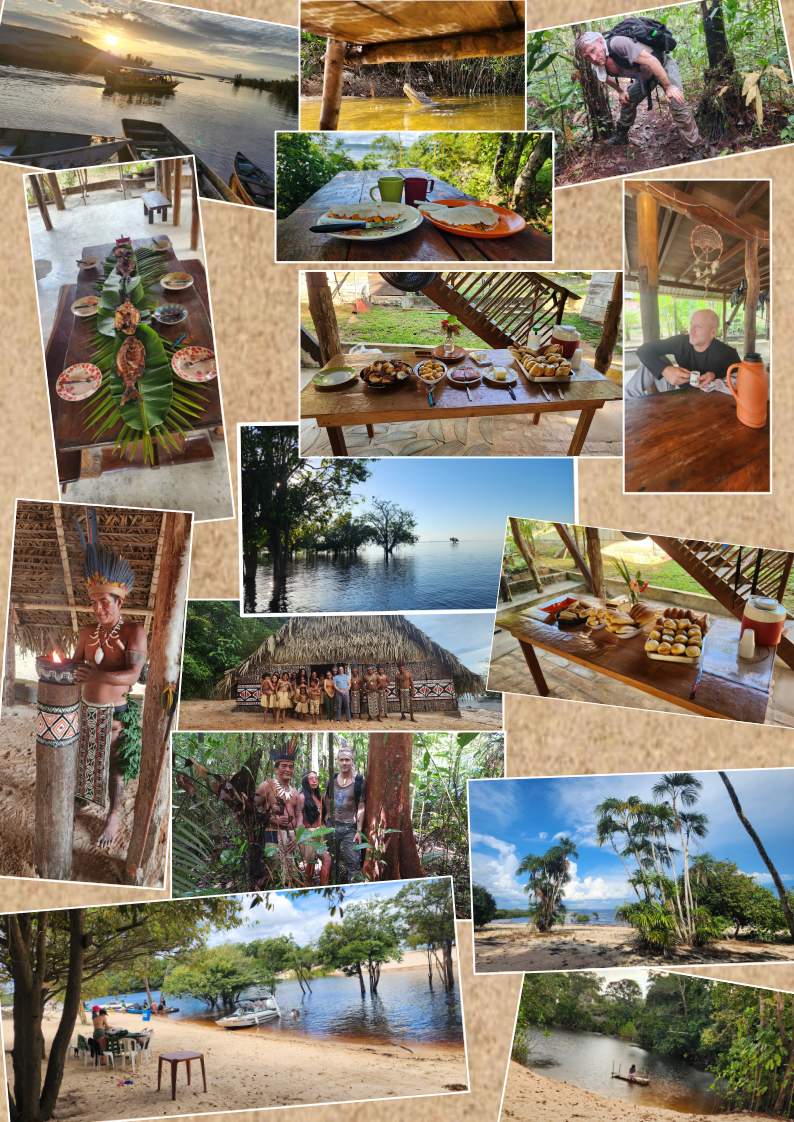
The Oca is a traditional communal house: one large, open room under a single roof, with hammocks instead of beds. There is groundwater and there are sanitary facilities. Electricity and satellite internet are available around the clock, supplied by a battery storage system that bridges a failure of the public grid for 30 hours on average; there is no air conditioning and there are no private room doors.
It does not stand in the middle of the village, but far out on the periphery, on the edge of the village in its own patch of forest. From the property, a forest path about 50 metres long leads out to the village's dirt track, and from there it is another 300 metres or so before you meet anyone at all. At weekends, music may drift over from the village. Those who cook, drive and guide here live locally — this village life is not a concept, but simply the way things work here.
Sleeping in a hammock
- You lie diagonally, not lengthways — then your back lies flat and it is surprisingly comfortable
- Most people sleep better than at home after the second night
- At night it cools down to 23 degrees — in a hammock this can make you feel chilly, especially in your back. That is why we provide blankets: to lie on under your back, or to wrap yourself up completely if you feel like it
- The mosquito net is closed in the evening — even if no mosquitoes are to be seen
The daily rhythm
- On the equator, the sun rises at around six and sets at around six in the evening all year round
- The day starts early — the most interesting hours are before eight
- At midday it gets hot. That is the time for the hammock and the river, not for activities
- In the evening it is dark and the forest becomes loud. That is part of the experience
Electricity and plugs
- Voltage: at Oca Valhalla the power supply is 230 volts at 60 Hz. Elsewhere in Brazil it is usually 127 volts in Manaus and 220 volts in other places. Devices rated 100–240 V (phone, laptop, camera) work everywhere.
- Sockets: Brazilian standard (type N) — three round pins. A European Europlug (thin, two pins) usually fits; the thicker German Schuko plug does not.
- A small travel adapter costs little and saves trouble. A multi-socket extension lead with one adapter will power several devices at once.
- Electricity is available 24/7 via a battery storage system. If the public grid fails, the storage bridges 30 hours on average.
- Small devices can be charged at any time. Please leave hairdryers, kettles and other high-consumption appliances at home — they put unnecessary strain on the storage system.
Connectivity and expectations
- Satellite internet via Starlink is available 24/7 — supplied via the battery set-up described above — and can be used without restriction for video streaming
- Mobile signal on the river and in the forest: unreliable to non-existent
- Many guests find that it is precisely this radio silence while out and about that is the real restorative factor
Important to know before booking
Oca Valhalla is a deliberately nature-oriented place to stay in the middle of the Amazon rainforest — not a leisure resort with road access, permanent security staff or professional emergency services in the village. So that you arrive well prepared and can enjoy your stay in a relaxed way, please consider the following before booking:
- Medical care and transport: There is a public accident and emergency department in Manaus. Depending on the weather, water level, time of day and available boat connection, it may take several hours to reach it. Between 6 pm and 6 am there is no regular boat service; night-time transport is only available to a limited extent and generally costs about twice as much.
- Help in an emergency: In the event of an accident, we will help as quickly and as best we can to get the person concerned to a public emergency department. However, the cost of the entire transport is borne by the guest concerned. Suitable travel health and travel insurance is strongly recommended; it covers treatment and repatriation, but usually only covers official medical transport with a Nota Fiscal — a privately arranged boat or an Uber is not included. Plan your own reserve for this (Chapter 13).
- Sleeping in a hammock: Before booking, please judge for yourself whether a hammock will be sufficiently comfortable and restful for you over several nights.
- Natural surroundings: The Oca is situated in a patch of forest. Branches, large thorny palm fronds or fruit can fall unexpectedly. Particular attention is important during heavy rain and storms; this natural risk cannot be ruled out completely.
- Wildlife: Encounters with animals are, in principle, part of the possible nature experience in the Amazon, even if they are not an everyday occurrence. These include, for example, snakes, scorpions, fire ants, peccaries (forest pigs), caimans and, in rare cases, jaguars. Please therefore always follow the advice of the local people.
These particularities are not meant to deter you, but to enable an informed decision: you are visiting an unspoilt habitat with extraordinary nature and correspondingly different conditions from those of a classic holiday resort.
Portuguese for the journey
English is of little help in Manaus and none at all in the village. Nobody expects perfection — but every attempt is noticed and warmly received. The pronunciation given is an approximation, not a phonetic transcription system.
Greetings and courtesy
| English | Portuguese | Roughly pronounced |
|---|---|---|
| Good morning | Bom dia | bong jee-a |
| Good afternoon (from midday) | Boa tarde | boa tar-jee |
| Good evening / good night | Boa noite | boa noy-chee |
| Hello / bye | Oi / Tchau | oy / chow |
| Thank you (said by a man) | Obrigado | oh-bree-gah-doo |
| Thank you (said by a woman) | Obrigada | oh-bree-gah-da |
| Please | Por favor | poor fa-vor |
| You're welcome | De nada | jee nah-da |
| Sorry / excuse me | Desculpa | dish-kool-pa |
| Yes / no | Sim / Não | sing / nowng |
| How are you? | Tudo bem? | too-doo beng |
| Fine, thank you | Tudo bem, obrigado | too-doo beng oh-bree-gah-doo |
| My name is … | Meu nome é … | meh-oo noh-mee eh |
| I am German (man / woman) | Sou alemão / alemã | soh ah-leh-mowng / ah-leh-mang |
Understanding and being understood
| English | Portuguese | Roughly pronounced |
|---|---|---|
| I don't understand | Não entendo | nowng en-ten-doo |
| Do you speak English? | Você fala inglês? | vo-seh fah-la een-glays |
| More slowly, please | Mais devagar, por favor | mice jee-va-gar poor fa-vor |
| How do you say …? | Como se diz …? | koh-moo see jeez |
| Can you help me? | Pode me ajudar? | poh-jee mee a-zhoo-dar |
| I don't speak Portuguese | Não falo português | nowng fah-loo por-too-gesh |
Eating, shopping, getting around
| English | Portuguese | Roughly pronounced |
|---|---|---|
| How much does it cost? | Quanto custa? | kwan-too koos-ta |
| Too expensive | Muito caro | mweeng-too kah-roo |
| The bill, please | A conta, por favor | a kon-ta poor fa-vor |
| Water / cold water | Água / água gelada | ah-gwa / ah-gwa zheh-lah-da |
| Without sugar / without ice | Sem açúcar / sem gelo | seng a-soo-kar / seng zheh-loo |
| I don't eat meat | Não como carne | nowng koh-moo kar-nee |
| Very tasty | Muito gostoso | mweeng-too gos-toh-zoo |
| Where is the toilet? | Onde fica o banheiro? | on-jee fee-ka oo ban-yay-roo |
| Left / right / straight on | Esquerda / direita / reto | ish-ker-da / jee-ray-ta / heh-too |
| How long does it take? | Quanto tempo demora? | kwan-too tem-poo deh-moh-ra |
When it really matters
| English | Portuguese | Roughly pronounced |
|---|---|---|
| Help! | Socorro! | so-koh-hoo |
| I need a doctor | Preciso de um médico | preh-see-zoo jee oong meh-jee-koo |
| I have pain here | Estou com dor aqui | ish-toh kong dor a-kee |
| I am allergic to … | Sou alérgico a … | soh a-ler-zhee-koo a |
| Please call the police | Chame a polícia, por favor | sha-mee a po-lee-see-a |
| Pharmacy | Farmácia | far-mah-see-a |
| Hospital | Hospital | os-pee-tow |
A practical tip: download the Portuguese language pack in a translation app beforehand so that it also works without a connection. The camera function for menus is worth its weight in gold.
On the river and in the village
You are a guest in a community that lives there — not at a tourist attraction. On the Rio Negro, ribeirinhos, the river dwellers, live side by side with Indigenous families. Both have their own rhythm, guided by the water level and the light, not by the clock.
Most things fall into place by themselves. Still, a few things are good to know.
Dealing with one another
- Ask before taking photographs — especially of children and during rituals. A no is a no, and it is rarely given.
- Say hello — a “bom dia" in passing is taken for granted and opens more doors than any conversation
- Do not hand out sweets or money to children. It is well meant, but it creates dependency. If you would like to contribute something, talk to us.
- Buying handicrafts is the most direct way to leave something behind — and you take home something with a story.
In the forest
- Never set off alone — finding your way in the rainforest is harder than it looks
- Do not reach for trees or into the undergrowth without looking — occasionally something is sitting there that you would rather see first
- Closed shoes, trouser legs tucked into your socks, even on short paths
- Drink before you are thirsty — in this humidity you notice fluid loss late
On the water
- Life jacket in the boat, even on short trips
- Only swim at the spots recommended locally and follow the instructions of your local guide. Currents, water levels and visibility can change.
- Reapply sun protection — on the water the sun hits you from above and, reflected, from below
- Stow electronics in waterproof bags before you cast off
And nature
- Leave nothing behind — we take rubbish back to Manaus with us
- Do not take plants, feathers, shells or animal parts as souvenirs. Exporting them is also prohibited
- Keeping quiet brings more animals in front of the camera than any lens
Safety and emergencies
| For | Number |
|---|---|
| Ambulance service | 192 (SAMU) |
| Police | 190 |
| Fire brigade | 193 |
| Nearest hospital | Manaus. The boat trip alone takes roughly 35 to 45 minutes; for the entire journey to the emergency department, allow about two and a half hours during the day |
| German diplomatic mission | Embassy in Brasília, Consulate General in São Paulo — note the contact details before you travel |
The route to Manaus, stage by stage
So that you can plan realistically, here is an open breakdown of the process. The route to the emergency department consists of four stages: organising a boat, the trip across the Rio Negro, the onward journey by land and arrival at the hospital. All four are well rehearsed — how long they take depends above all on the time of day.
| Stage | During the day, best case | At night or in difficult conditions |
|---|---|---|
| Organising and preparing a boat | up to 60 minutes | two to three hours — between 6 pm and 6 am there is no regular boat service |
| Trip to Marina do Davi | roughly 35 to 45 minutes | about the same; in darkness, rain or low water the boat deliberately goes more slowly |
| Onward journey from the marina | an Uber or 99 usually arrives in about 10 minutes | 30 minutes or more; at this time of night, occasionally no driver will accept the trip to the marina |
| Drive to the hospital | roughly 40 minutes | similar, or quicker when the roads are empty |
All in all: during the day, the journey from the decision to the emergency department usually takes about two and a half hours. At night or in bad weather it can take considerably longer — four hours or more are then possible. That is how it is in a place without road access; we would rather tell you beforehand than have it come as a surprise.
Besides Uber and 99, there is the SAMU ambulance service (192). It can be reached in Manaus and can take over the stretch from the marina to the hospital; how quickly a vehicle will be available, however, cannot be guaranteed. That is why both are usually set in motion in parallel on site — the boat and the onward journey by land — and whichever route comes together first is used. The cost of transport is borne by the guest (see Chapter 10); night-time journeys generally cost about twice as much.
Who pays for the transport
This point is often misunderstood, so to be clear: travel health insurance as a rule only covers official medical transport for which there is a Nota Fiscal — the official Brazilian invoice. A privately arranged boat, an Uber or a driver from the village is not included. Whether a policy will nevertheless reimburse something like this in an individual case is anyone's guess; you should not count on it.
On the Rio Negro, you buy speed with money — that is how things work here. During the day, this remains manageable. At night, when a boat and crew have to be provided specially, the bill can come to several hundred euros. Keep a reserve ready for this: cash in the village, a card with a sufficient limit for Manaus. This is the preparation that saves the most time if the worst comes to the worst — because the question of payment has then already been answered.
Things to do beforehand
- Designate an emergency contact in Germany and let us know who it is
- Keep your insurance documents and your insurer's emergency number to hand
- Leave your itinerary with someone at home
- Install Uber and 99 while still at home and add a payment method — with working internet from the moment you land (Chapter 3), both are ready to use immediately
- Tell us in advance about any regular medication, allergies and relevant pre-existing conditions
- Ask your insurer in writing what is reimbursed outside official medical transport — and, regardless of the answer, plan a reserve for the boat and the drive (Chapter 3)
- The German Federal Foreign Office's crisis preparedness list (ELEFAND) — voluntary, but sensible
Common concerns, honestly answered
Isn't it dangerous?
Many risks can be considerably reduced through sensible preparation. Under normal conditions the village is roughly 35 to 45 minutes by boat from Manaus. Electricity and satellite internet are available around the clock; transport options and procedures are explained to you personally before the trip.
What about the mosquitoes?
Considerably fewer than elsewhere in the Amazon region — the reasons are given in Chapter 5. Insect repellent still belongs in your suitcase.
What about the animals?
Snakes, spiders, piranhas and caimans are part of the Amazon ecosystem. Encounters are rare during normal stays, but risks can never be ruled out completely. Only swim at recommended spots, stay with guided activities and wear closed shoes in the forest.
I don't speak Portuguese.
Nor does almost anyone else. We translate, and with the phrases from Chapter 11 you will get surprisingly far. Hands, laughter and a translation app cover the rest.
Do I need to be sporty?
Normal mobility is enough. The walks are on level ground, you help set the pace, and nobody has to come along. If you have any health limitations, let us know beforehand — something can almost always be arranged.
Can I sleep in a hammock?
Most guests surprise themselves. The trick is to lie diagonally — then your back is flat and you sleep better than you would expect. If you really cannot get on with it, let us know beforehand.
What if something happens?
If medical care is needed, onward transport to Manaus is organised. Under normal conditions the boat trip alone takes roughly 35 to 45 minutes; to reach the emergency department, you also need to add the time to get the boat ready and the drive through the city — together usually about two and a half hours during the day, longer at night. Chapter 13 shows the individual stages. Most things can be dealt with on site. Travel health insurance including repatriation is nevertheless strongly recommended — it covers treatment and the return flight, but not automatically the boat or the car to the clinic. Plan your own reserve for this; Chapter 13 explains why.
Ready for the Rio Negro?
Tell us about your trip.
Send us your preferred dates via the secure form. Availability is checked personally; an enquiry is not yet a booking confirmation.
Check availability